%2Fhttps%3A%2F%2Ffbi.cults3d.com%2Fuploaders%2F13786535%2Fillustration-file%2F8f54b3bf-0127-4986-baf3-d4d7fb686ab5%2Fgogobatch2d_display_large.jpg)
GO-GO AirBoat
by Qelorliss
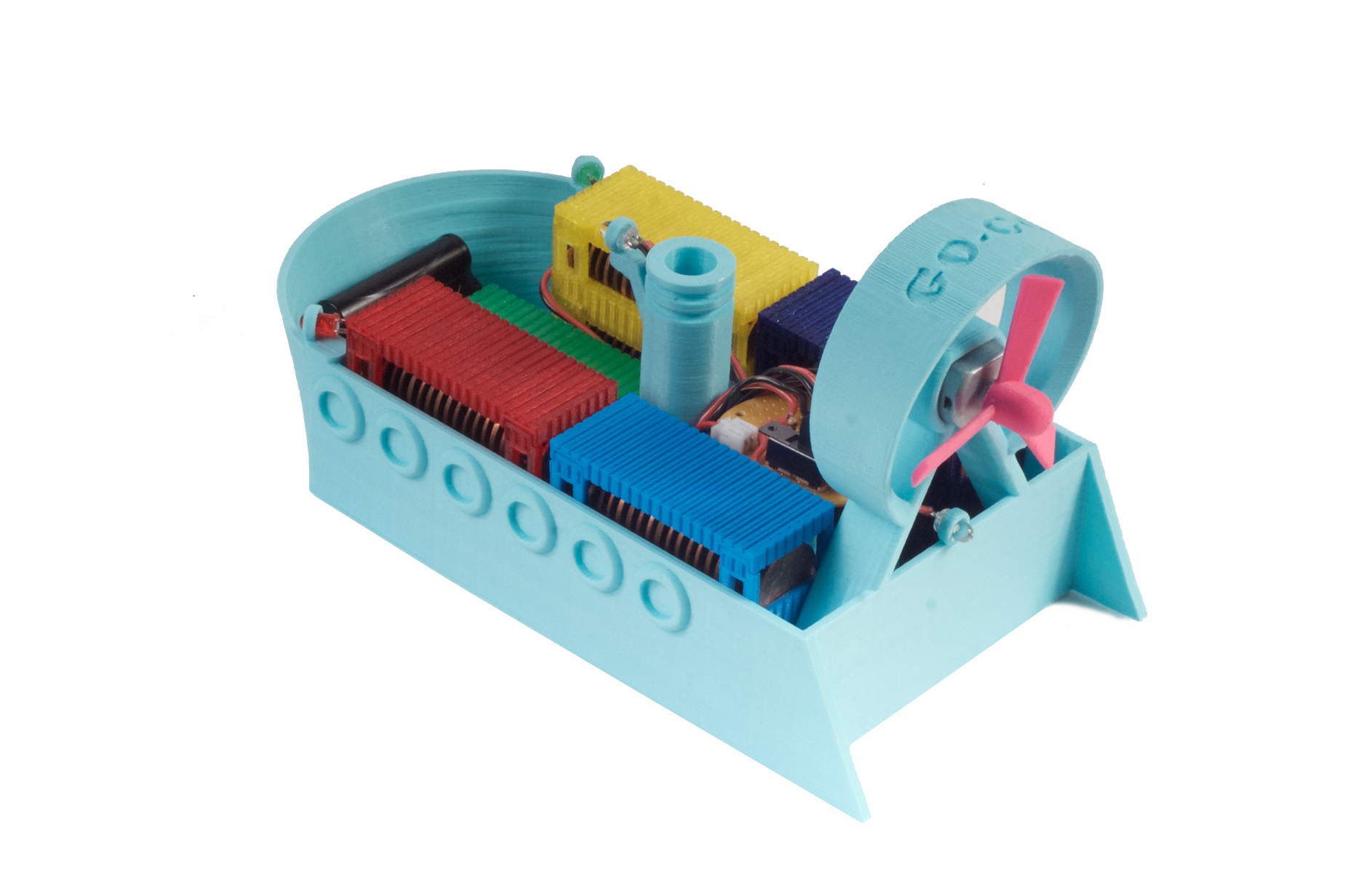
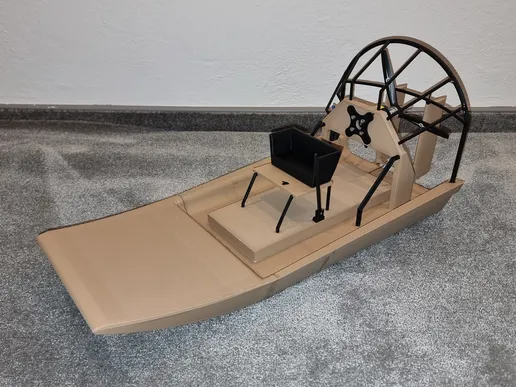
___ ##___[GO-GO AirBoat](https://www.youtube.com/watch?v=KVHloo4cTNI) is a physics concepts and electronics learning kit.___ ___ - GO-GO AirBoat is a payload-sensing, motorized, propeller airboat. - When GO-GO AirBoat reaches full capacity, watch the motor rev to life, spinning the propeller, and watch GO-GO go! How many pennies can you load before GO-GO goes? Will it sink or will it float? Load your lifesavings aboard, and wave "Bon voyage!" to your GO-GO AirBoat! - Load your cargo containers with up to 20 pennies each (US cent tested). The cargo containers are infinitely stackable! GO-GO's cargo bay area can support up to 5 columns of cargo containers. Many combinations of load and weight distribution possible. Experiment! - Provided instructions include derivation of the _"Maximum Number of Pennies"_ equation to stay afloat with your chosen cargo configuration. - Simple to print! There are only four STL files needed to construct your GO-GO AirBoat and cargo containers so it's easy to do. - GO-GO AirBoat senses when to embark on its long haul across the sea when it is fully loaded to capacity with its valuable cargo. A floating piston inside the boat's smokestack is free to move with the water level and triggers the motor to drive when a certain depth is achieved. This sensor employs a simple infrared LED, phototransistor, and a Darlington pair transistor amplifier stage for switching of a small DC motor. - The depth-sensor trigger point can be mechanically altered using different, floating piston heights of your own creation. - Gain hands-on experience with resistors, capacitors, diodes, LED's, DC motors, bipolar junction transistors (BJT's), Darlington pair transistors, phototransistors as triggers, circuit board layout, and soldering. - The GO-GO AirBoat features a series of basic, discrete component, electronic constructions to help young engineers and future scientists better visualize electrical components, their wiring, and their roles in electronic circuit
Similar models
%2Fhttps%3A%2F%2Ffbi.cults3d.com%2Fuploaders%2F14369123%2Fillustration-file%2Fd0e16439-03b0-43c7-98c7-9df00ca961ea%2Fassembly5.png)